

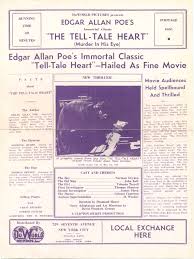
A young man (Norman Dryden) is living with an elderly man (John Kelt). The old man has a deformed diseased eye. Lately the young man has become fixated on the old man’s eye. The young man’s mental state causes him to believe that the eye is following him around. Although he has nothing to resent about the old man himself, he has come to be repulsed by the eye.
The young man, having recently become ill, is recuperating and is visited by his love, a young woman (Yolande Terrell). The young woman takes the young man out to get some fresh air and sunshine. While the young man is out with his love, he is lighthearted and enjoys himself. Once in a while he gets a vision of the old man’s eye but manages to shake the images.
When he returns to the house the young man once again becomes melancholy. He sends his love away and, again, becomes obsessed with eye. He begins to feel that he must destroy the eye, or he will be consumed by it. Night after night the young man tries to stop his urges. After a week of fighting his inner demons, the young man succumbs to temptation and kills the old man. He cuts him up and buries him under the floorboards.
A knock at the door brings two police investigators (Thomas Shenton and James Fleck). They tell the young man that they received a noise complaint. The young man invites the police in to search. As he entertains the police, he begins to hear the incessant beating of the old man’s heart coming from under the floorboards.
“The Tell Tale Heart” AKA “Bucket of Blood” was released in 1934 and was directed by Brian Desmond Hurst. It is a British horror film and a quota quickie. The film is based on the 1843 short story by Edgar Allan Poe. It is one of many films based on Poe’s story and is believed to be the earliest sound version, as well as being a little obscure.
Like many films from the early thirties, the atmosphere is dark and somewhat expressionistic. Sets are minimalistic, in part due to the low budget, but the lack of set-work does add to the hopelessness experienced by the young man. The sparse surroundings exacerbate the young man’s depression and descent into madness.
The acting, what there is of it, is very stilted and the pacing is slow. There is also some strange padding with the young man and his girlfriend spending a lot of time together. The film was also done during the Hayes Commission so there is no blood and basically no dismemberment which goes against what the young man admitted to doing to his patron.
It’s an interesting little gothic drama from the “Golden Age” of film. Not great but not bad.