

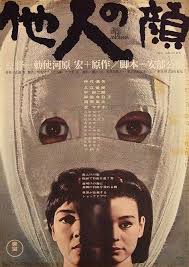
Mr. Okuyama (Tatsuya Nakadai) was an engineer whose face was disfigured due to an industrial accident at work. Okuyama’s ravaged and scared face hides behind bandages. His disfigurement is now affecting his sanity. The relationship between Okuyama and his wife (Machiko Kyo) has also become strained to the point where they have no physical contact. Okuyama starts seeing a psychiatrist (Mikijiro Hira) for his depression.
The psychiatrist, who seems to dabble in realistic looking prosthetics, proposes a radical and somewhat unorthodox solution. He can, using a special material, construct a prosthetic mask that Okuyama can wear during the day. That way he can go about his daily routine without being accosted or stared at. The experimental mask needs to be molded using the features of an existing face in order to create the mask. To make the mold for the mask, they need to have someone volunteer to be the model.
The psychiatrist takes Okuyama to a shopping center where they find a man that has similar features to those of Okuyama. They offer the man ten thousand yen to be the model for the prosthetic and he eventually accepts. The psychiatrist makes a mold of the man’s face and then creates the mask.
Before he applies it to Okuyama’s face, he gives him some warnings and instructions. He tells Okuyama that he can only wear the mask for 12 hours before it will suffocate his face and cause further damage. He also warns Okuyama that the mask may alter his personality. His final instruction is to report back to him about everything he did and felt while wearing the mask. Okuyama gives him more than he bargained for.
“The Face of Another” AKA “Tanín no Kao” was released in 1966 and was directed by Hiroshi Teshigahara. It is a black and white Japanese New Wave film with science fiction and horror elements. The film was based on the 1964 novel by Kobo Abe. The movie is more artistic and thought provoking than it is science fictional. There are also some propaganda undertones in the film. The end is slightly ambiguous.
It is a very slow-moving story that is more of a stylized drama of how one’s personality is determined by how one is perceived. Intertwined with that is a cultural lesson on the effects of the atomic bombing in Japan. It looks at the human condition, especially concerning relationships and how one’s self worth is dependent on how we think others perceive us.
The movie contains a sub story about a young woman who is suffering from a disfigured face due to the bombing of Nagasaki. Her story is vastly different from Okuyama’s but the emotions they feel are similar in that their respective conditions result in loneliness and the fear of not being accepted. They feel alienated in society and without a clear identity. In this instance the mask gives Okuyama the freedom to be whoever he wants without being confined by social norms whereas the young woman does not have the same freedoms.
The main question is, is Okuyama taking on a personality dictated by the mask or is the mask bringing out his secret self.