
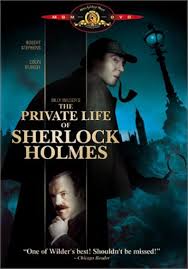
Private Detective Sherlock Holmes (Robert Stephens) and his friend and roommate Dr. John Watson (Colin Blakely) are in their apartment as Sherlock laments the fact that there are no real crimes anymore, thus revealing the fact that he is suffering from an acute case of boredom.
As he whines, an invitation arrives to attend the final performance of the Russian Imperial Ballet. Along with the tickets comes a desperate plea for Holmes’ help. Holmes doesn’t want to go but Watson manages to talk him into it. After the ballet Holmes is invited to an after party to celebrate the end of the London run of the performance. Holmes is then taken to see the prima donna of the show, Madame Petrova (Tamara Toumanova). The ballerina wants Holmes to father a baby with her believing that a child from the union would have her beauty and his brains. To get out of the situation, Holmes implies that he and Watson are gay.
After they return to their flat Watson is ranting about his reputation being destroyed by Holmes’ implication when a cabbie comes to the door with a woman. He tells Holmes that he fished her out of the river. The woman, who says she doesn’t remember her name, has a note clenched in her had with Holmes’ address on it. The woman turns out to be Gabrielle Valladon (Genevieve Page) and is from Brussels. She is in London looking for her husband who seems to have disappeared while he was working as an engineer in London.
Holmes’ investigation attracts the attention of his older brother Mycroft (Christopher Lee). Mycroft warns Holmes to stay out of the investigation. Holmes, of course, jumps in with both feet. Holmes eventually learns that whatever is happening involves the British government, a troop of midget acrobats and the Loch Ness Monster.
“The Private Life of Sherlock Holmes” was released in 1970 and was directed by Billy Wilder. The film was also written and produced by Wilder and I.A. L. Diamond. It is a British and American crime mystery comedy.
It was an interesting plot and had potential but ended up being nondescript. I don’t think I’ve ever seen a Sherlock Holmes movie that was ever as fascinating or as well done as the actual stories written by Sir Arthur Conan Doyle. Sadly, this one is no exception. It tried to be titillating with the homosexual references, but it just ended up being ambiguous. It’s not a bad film, but nothing special either.
Supposedly, the film was to be a collection of four stories and run about three and a half hours. It was then cut down to a little over two hours and entailed only two stories. Subsequent releases on DVD and Blu-Ray were restored to incorporate the deleted scenes. Having not seen any of the deleted scenes, whether or not the film would have been better with the cut stories restored I couldn’t say.
One of the props for the film was a 30 ft model of the Loch Ness Monster that consisted of the head and two humps. Director Wilder didn’t want the humps and had them removed. This screwed up the buoyancy of the prop and as a result the head sank. The sunken model was rediscovered in 2016 by a Scottish expedition looking to find the actual Loch Ness Monster.