

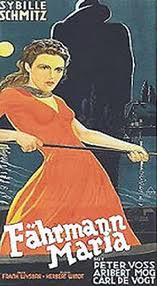
An old ferryman (Karl Platen) spends his days taking people from one side of a river to the other. He has been doing it for fifteen years. One day there is a man dressed in black waiting to be taken across to the other bank. The man in black is death (Peter Voss). Death takes the ferryman away. With no one to run the ferry, people must travel farther away to cross a bridge. Soon stories begin to be whispered about the area and how death lurks by the river and in the moors surrounding it. The village still needs a ferryman, so the job is posted, but no one applies.
One day a young vagabond woman named Maria (Sybille Schmitz) comes to town. She sees the advertisement for the job of ferryman. The mayor of the village, Mayor Hegemann (Eduard Wenck), offers her the position of ferryman. She accepts. He then tells her of her duties as ferryman and where the ferry is. Maria moves into the ferryman cottage and starts her job.
One evening Maria is finished for the day and is getting ready to go to bed when she hears the signal that someone is on the other bank waiting to cross the river. When she gets to the other side, she finds an injured man (Aribert Mog). She helps him into the boat. He tells her that he is being pursued and she must hurry. Maria quickly crosses the river as a group of men on horseback reach the bank. She puts the man in her bed and tells him she will get some herbs in the nearby meadow to help with his fever.
As Maria tends to the young man they begin to fall in love. When death returns to claim the man, Maria realizes who he really is. Desperate, Maria decides to attempt to outwit Death to try and save the life of the man she loves.
“Fahrmann Maria” AKA “Ferryman Maria” was released in 1936 and was directed by Frank Wisbar. It is a German fantasy horror film.
Wisbar also directed the American remake of the film, “Strangler of the Swamp” in 1946. Technically, “Strangler of the Swamp” is not a remake so much as a reimagining of the original story. In this version, the story is more of a folklore romance type film as opposed to a plain horror story. Even so, the film is sufficiently moody and eerie. The cinematography is wonderful.
The movie has quite a few interesting German Expressionistic touches. They add some nice nuances to the dark and somber atmosphere of the film. Some believe that this was one of the last films that used German expressionism before the Nazis came along and ruined everything for everybody.
The restrictions of artistic freedom, and the fact that Wisbar’s wife was Jewish, resulted in Director Wisbar eventually escaping Germany. Working in the U.S. Wisbar remade the movie as a straight up horror film.