

Edmundo Nobile (Enrique Rambal) and his wife, Lucia (Lucy Gallardo) are having a dinner party. The guests are the cream of high society. The party takes place after an evening at the opera. There are eighteen guests. The table is set and the food is ready. As the guests arrive, the staff begins to leave until the last servant remaining is the majordomo, Julio (Claudio Brook).
After the meal everyone moves to the salon to listen to Blanca (Patricia de Morelos) play the piano. After the performance everyone begins to say good night to each other in preparation to leave. Instead of going, they all begin milling around aimlessly. Soon, they all settle down and go to sleep on sofas and the floor. Edmundo and Lucia are confused and wonder why no one is leaving. Eventually, they too lie down and sleep. Julio falls asleep in the dining room.
The next day they all wake up. Since the staff is still gone, Lucia has Julio bring in leftovers from dinner to feed everyone. Once he steps back into the salon he too is trapped. Soon after that the guests start to realize that they are unable to leave. When they get to the door of the salon, they stop and then wander back where they were. One of the guests, Sergio (Antonio Bravo) appears to be ill. Another guest, Doctor Carlos Conde (Augusto Benedico) tends to Sergio, but eventually the ill man dies.
The guests end up trapped for weeks. They put Sergio’s body in one of the closets off the salon and try to make it airtight in an effort to keep out the smell. They use another closet as a toilet. Two of the guests, Eduardo (Xavier Masse), and his fiancé, Beatriz (Ofelia Montesco) commit suicide in another closet. They manage to break a wall enough to expose a water pipe in order to get water. Sheep that had wandered into the house walk into the salon and are killed and roasted to keep everyone fed. As the days pass the trapped begin to fight among themselves and blame each other for what is happening. The guests start to look at Edmundo as the problem and believe that if he dies, they will be free.
Outside of the house the authorities keep vigil along with the townspeople. They also seem to be unable to enter the house. They have no idea what is going on inside.
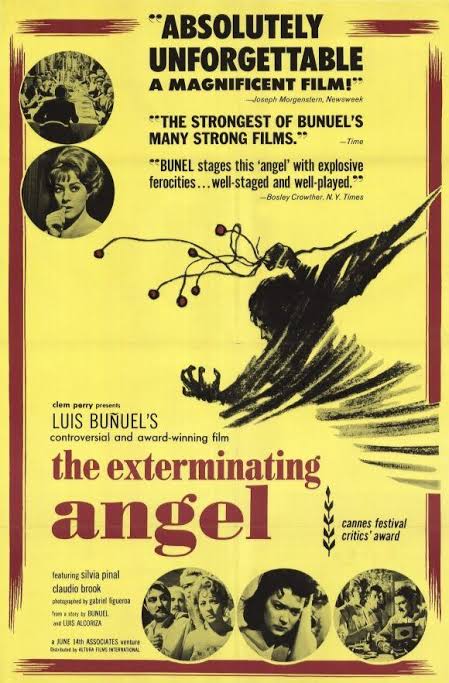
“The Exterminating Angel” was released in 1962 and was directed by Luis Bunuel. It is a Mexican psychological dark satire fantasy with horror aspects and surrealism. The movie was banned in Russia. It seems they believe that people unable to “leave a party” is offensive and anti-government.
As their confinement continues, societal norms begin to crack. Suppressed urges and personality quirks begin to leak out. We saw a similar themes concerning the breakdown of stressed societies in films such as “The Mist” 2007, William Golding’s “The Lord of the Flies” and even the “Twilight Zone” episode, “The Monsters Are Due on Maple Street” where trapped people begin to blame each other for their unhappy circumstances. In this case the story is more melodramatic. There is no specific interpretation of the film, and the viewer is left to make of it what they want. More a class study than horror, the film still ended up being fascinating. It does have the look of a political essay on the upper class and how a society can quickly deteriorate when faced with human frailty and hypocrisy.
You will notice, especially in the beginning, that some scenes repeat themselves. Director Bunuel said that it was a conscious decision and that he had repeated pieces of scenes somewhere between 20 and 27 times. Bunuel also has a cameo as a severed hand during a dream sequence.