

In 1962 President John F. Kennedy committed the United States to sending a man to the moon and retuning him safely back to Earth. Kennedy made his remarks in a speech at Rice University. NASA, given their marching orders, was committed to accomplish its directive by the close of the decade.
The directive was called Project Apollo. In the end, it consisted of 12 manned missions, six of them actually landing on the moon. The missions where men actually set foot on the Moon were Apollo 11, 12, 14, 15, 16 and 17. Twenty-four astronauts went to the Moon, twelve actually walked on it. The Apollo Project lasted from 1968 to 1972.
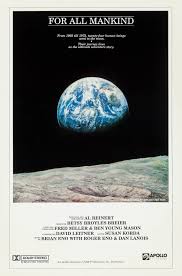
“For All Mankind” was released in 1989 and was directed by Al Reinert. It is an American documentary. The film uses original footage from missions 7 through 17. The flow of the film is such that it looks like one continuous mission. Narration of the film was done by the astronauts themselves. Interviews from thirteen astronauts were used in the film. The film also includes some footage from an earlier program, Project Gemini.
Neil Armstrong, the leader of the Apollo 11 mission, was the first human to set foot on the Moon. The astronauts of Apollo 8 were the first men to actually see the far side of the moon, although not very clearly, with their own eyes.
The title of the film mainly comes from a plaque planted on the Moon by the astronauts of the Apollo 11 mission. The plaque reads:
- Here men from the planet Earth
- First set foot upon the Moon
- July 1969, A. D.
- We came in peace for all mankind
The Film begins with an excerpt of President Kennedy's speech at Rice University. Director Reinert modified the excerpt slightly. Instead of Kennedy saying “people” Reinert instead dubbed in the word “mankind”, from another of Kennedy’s speeches, to coincide with the title of the film. Reinert and Editor Susan Korda went through six million feet of film and eighty hours of interviews to create the documentary.
The Apollo program itself, which ran from 1960 to 1973, cost approximately $25.8 billion which equates to about $257 billion to $318 billion today.
At one point in the film there is a shot of the moon seen through the window of the capsule. This image was described by Ken Mattingly in one of his interviews. Reportedly, Reinert couldn’t find footage of the event, so he took a film crew to Johnson Space Center Museum, pasted a picture of the moon on a hatch cover and filmed it to show what Mattingly described.
Movie
Kennedy Speech