

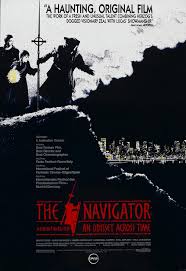
In 1348 in ancient Cumbria, England the Black Death is ravaging the countryside. Griffin (Hamish McFarlane) is a young boy living in a small mining village that hasn’t yet been affected by the plague. Griffin is known in his village for his ability to see the future. His brother, Connor (Bruce Lyons), has been away from the village but now returns with stories of the plague and its effects on those that succumb to its horror. The village is in a quandary about what to do until some infected travelers approach the village. They decide something needs to be done to try to save their town.
Griffin has been having visions about a church and a spire. He tells the villagers that the church is in a great city and to access the city they need to dig through the Earth and come out on the other side of the world where the cathedral is supposedly located. A small contingent of villagers comprised of Griffin, Connor, Arno (Chris Haywood), Searle (Marshall Napier), Ulf (Noel Appleby), and Martin (Paul Livingston) decide to take some of their copper ore and make a pilgrimage to the city. Once there they intend on melting the copper and casting it into a cross to place on the cathedral as an offering to God hoping to ward off the plague.
The pilgrims work their way down the tunnel and eventually find themselves in an area where the walls are smooth. At the end of the tunnel are metal rings going up. The guys go up the ladder and find themselves in a modern-day world at the edge of a large city. In the distance they can see lights shining brightly in the dark. Having never seen a city, and overwhelmed at what they are seeing and experiencing, the visitors become separated but are determined to fulfill their promise of placing a cross at the top of the highest church spire. That is until Griffin experiences a cacophony of images that he says will end in the death of one of the pilgrims.
“The Navigator: A Medieval Odyssey” was released in 1988 and was directed by Vincent Ward. It is an Australian-New Zealand fantasy movie with time travel elements.
At times the movie can be a little confusing. The images and experiences portrayed are based on the view of the pilgrims, so confusion is part of the plot. The pilgrims are like children who were never allowed to cross the road alone but now find that the world outside of their village is far more dangerous than they expected.
The film also changes from black and white to color throughout. Most of the old-world scenes are in black and white while most of the current day scenes are in color. The premonitions Griffin experiences are also in color. The imagery and cinematography are fascinating and are the main highlights of the film. Everything that happens in the city occurs at night. The landscape, therefore, is dark and menacing which makes the experiences of the travelers frightening and somewhat overpowering. Although it may be a little challenging to understand, and slightly disjointed, the ending is strangely satisfying, even though it is depressing.
I’m still not really sure what the horse was for.
The church used in the film was St Patrick's Cathedral in Auckland, New Zealand.